

If you've been researching options for replacing a full arch of teeth, you've run into the term All-on-4, or All-on-X, or some practice's branded version of the same idea. You've probably also seen "teeth in a day" attached to it.
The concept is real and it works well. But the marketing around it tends to skip the parts patients most need to understand. Let me walk through what it actually involves.
What All-on-X Is
All-on-X replaces an entire arch of teeth — upper, lower, or both — with a fixed bridge anchored to a small number of dental implants, typically four to six per arch.
The "X" is just a variable. All-on-4 means four implants, All-on-6 means six. The number depends on your bone volume, your bite force, and which arch we're treating. Lower jaws often do well with four; upper jaws frequently need six, because upper bone is softer.
The key word is fixed. The bridge is screwed onto the implants. You don't take it out. You brush it like teeth. It doesn't cover your palate, it doesn't move when you eat, and it doesn't need adhesive.
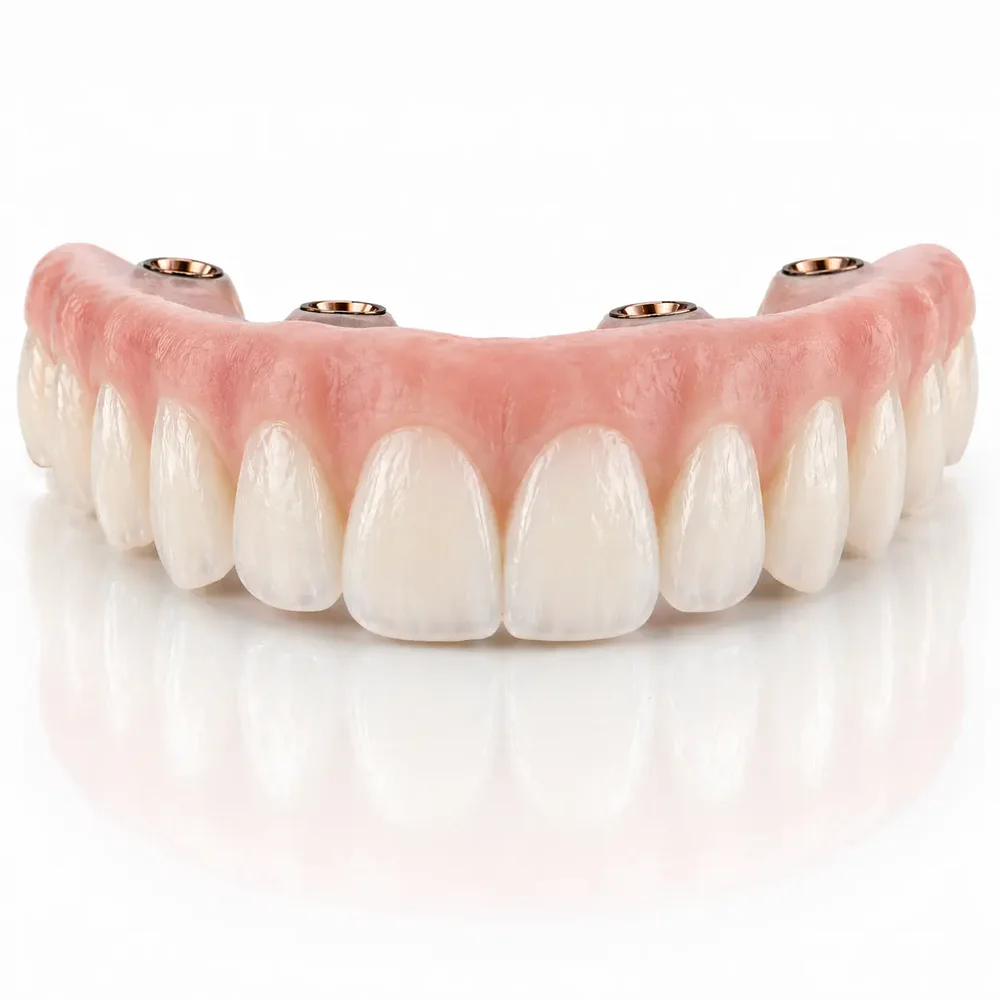
That's the photo most people find clarifying. Those metal-lined openings are where the bridge screws down onto the implants. Once it's seated, they're filled and invisible.
Why Only Four to Six Implants?
A natural adult arch has 14–16 teeth. Replacing each one with its own implant would mean an enormous number of surgeries, and most people don't have the bone for it anyway.
All-on-X works because a rigid, full-arch bridge distributes force across the whole span. Each implant isn't carrying one tooth — the structure shares the load.
The other piece of engineering is tilting the back implants. By angling the posterior implants forward, we can anchor them in the denser bone at the front of the jaw and avoid anatomy that would otherwise be in the way — the sinus in the upper jaw, the nerve canal in the lower. This is why many people who were told they "need a bone graft first" can be treated without one.
What "Teeth in a Day" Actually Means
This is the part worth being precise about, because it's where expectations go sideways.
What is true: You can have failing teeth removed, implants placed, and walk out the same day with a fixed set of teeth attached to those implants. You do not go home toothless. You do not spend months in a removable denture waiting to heal.
What's often left out: The teeth you leave with that day are a provisional — a temporary bridge, usually printed or milled from PMMA, a dental acrylic. It's functional and it looks good. It is not the final restoration.
Here's the actual sequence:
- Day one — teeth removed, implants placed, provisional bridge attached the same day
- Months one through four — the implants integrate with your bone. You eat a modified diet at first and work back toward normal.
- Around month four to six — once integration is confirmed, we take final records and fabricate your definitive bridge, usually in zirconia.
- Final delivery — the permanent bridge is placed.
So "teeth in a day" is honest about day one. It just isn't the whole timeline. Anyone who tells you the thing you receive on surgery day is your permanent restoration is either being careless or isn't telling you the truth.
The provisional phase isn't wasted time, either. It's a live test drive. How those temporary teeth look in your face, how you speak with them, where the bite lands — all of that informs the final design. If the tooth length is off or the midline isn't centered, we find out during the provisional, not after the permanent bridge is made.
Who Is a Candidate?
All-on-X generally makes sense if you:
- Have advanced periodontal disease with teeth that can't be saved
- Have widespread decay or failed restorations across an arch
- Are already wearing a full or partial denture and want something fixed
- Have enough bone to anchor implants — or enough that tilting makes it possible
It's less likely to be the right answer if you have a handful of healthy teeth that could be saved. Removing salvageable teeth to simplify a treatment plan isn't good dentistry. If most of your arch is sound, individual single-tooth implants or a bridge may serve you better.
Smoking meaningfully raises the risk of implant failure. Uncontrolled diabetes interferes with healing. Neither is automatically disqualifying, but both need an honest conversation first.
"I Was Told I Don't Have Enough Bone"
This is one of the most common things we hear, and it's often outdated information.
Tilted posterior implants avoid a lot of grafting that used to be mandatory. Beyond that, when the upper jaw has lost severe bone height, zygomatic implants anchor into the cheekbone instead of the upper jaw entirely — bone that essentially never resorbs. Remote anchorage implants use a similar principle in other regions.
These are advanced techniques and not every practice offers them. But "you don't have enough bone" frequently means "you don't have enough bone for the approach I offer." It's worth a second opinion with a CBCT scan before accepting that you're out of options.
How It Compares to Dentures
We've written a fuller comparison of implants and dentures, but the short version:
A conventional upper denture covers your palate and relies on suction. It moves. It dulls taste and temperature. And because nothing is stimulating the bone underneath, the ridge keeps shrinking — which is why dentures need relining and fit worse over time.
All-on-X is fixed, leaves the palate open, preserves bone around the implants, and restores far more bite force. Snap-in dentures sit between the two: removable, but implant-retained so they don't shift.
What About Cost?
Full-arch implant treatment is a significant investment, and the number varies with how many implants, which materials, whether extractions are needed, and whether one or both arches are treated. We've covered this in detail in our guide to dental implant costs in Florida.
What I'll say here: compare what's actually included. Some quotes cover surgery only, with the final bridge billed separately. Ask whether the provisional, the final restoration, the CBCT, and follow-up adjustments are in the number you're given.
Living With It
Day-to-day care is simpler than people expect, but it isn't nothing:
- Brush twice daily, same as teeth
- Clean underneath the bridge — a water flosser is the practical tool here, since you can't floss between a fixed bridge and your gums conventionally
- Keep your recall visits. We unscrew the bridge periodically to clean beneath it and check the implants.
- Expect a soft diet early on while the implants integrate — our guide on what to eat after implant surgery covers that phase
Implants don't decay. But the tissue around them can become inflamed, and peri-implantitis is the main long-term threat to implant survival. Hygiene and regular checks are what protect the investment.
Is It Right for You?
The only way to know is a CBCT scan and an exam. Bone volume, bite, and what's left of your current dentition determine whether All-on-X is appropriate — or whether something less involved would serve you better.
At Hope Dental Implant Center in Maitland, FL, we handle full-arch implant treatment from planning through final restoration, with our in-house lab making the provisional on surgery day.
If you've been told you're not a candidate, or you want a clear picture of what treatment would involve, schedule a consultation or call (407) 853-8877.